The following data is determined for each link.
- Fleet composition class to be applied:
The fleet composition class to be applied results from the HBEFA link class of the link type and the link attribute Urban:
|
HBEFA link class |
Urban |
Fleet composition class to be applied |
|
Motorway-National or Motorway-City or Semi-Motorway |
--- |
Motorway-National |
|
Other |
No |
Rural |
|
Other |
Yes |
Urban |
|
Note: If you use uniform fleet compositions for each demand segment, the fleet composition for Urban is always applied. |
- Gradient class:
The gradient class results from the attribute Gradient based on the following classification:
|
Value range |
Gradient class |
|
< -5 % |
-6 % |
|
-5 % to below -3% |
-4 % |
|
-3 % to below -1% |
-2 % |
|
-1 % to below 1% |
0 % |
|
1 % to below 3% |
2% |
|
3 % to below 5% |
4% |
|
5% and more |
6% |
- Level of Service (LOS):
Depending on the parameter setting, the LOS is determined either directly from the content of the selected attribute or by classification according to the set attribute with reference to the four set class limits for the five traffic situations under consideration (LOS).
|
Note: If you calculate by time interval and the set subattribute type is AHPI with values for time intervals, the LOS will be calculated per analysis time interval as well. |
- Static traffic situation (i. e. without the LOS share):
The urban/rural classification results directly from the link attribute Urban, the HBEFA link class directly from the link type. The speed class is determined on the basis of the set link attribute (default: v0), while only certain values are possible according to the traffic situation scheme in HBEFA (depending on urban/rural and link class):
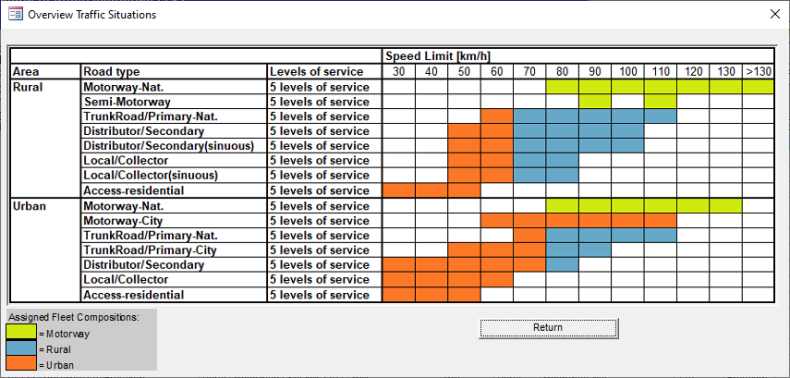
If there is a traffic situation whose speed does not vary by more than 5km/h, which matches the characteristic urban/rural and the link class, it will be allocated. In the case of two such traffic situations (e.g. 55km/h), the one with the higher speed will be allocated. If no traffic situation fulfills this condition, the nearest traffic situation with the same link class will be used.
If no traffic situation matches the specified combination of urban/rural and HBEFA link class, the default traffic situation Rural/Motorway-National/80km/h will be used.
For the used fleet composition, the emission factor weighted by the static traffic situation, the level of service and the gradient class will be multiplied for each pollutant to be calculated by the value of the volume attribute (AP) specified for the demand segment and by the length of the link. The result is the warm emission for this pollutant, this link and this demand segment based on the analysis period. Multiplied by the respective projection factor, the amount is saved in the respective link attribute (AP and AH) and added to the network-wide emission (AP and AH).
If the calculation is additionally carried out per analysis time interval, the emission factor is determined once per interval due to the interval-dependent LOS and multiplied by the volume value for this interval and the length of the link. The result is then saved in the subattribute associated with the analysis time interval and added to the network-wide time-dependent emission.
|
Note: Practical information on modeling and classifying traffic data according to the HBEFA traffic situations can be found in the HBEFA Traffic Situations - Application guidelines (Umweltbundesamt 2025) published by the Federal Environment Agency. |
Calculated pollutants
The following pollutants can be calculated in Visum. The pollutants are divided into three groups:
Group 1: Fuel consumption
|
Element |
Description |
|
FC |
Fuel consumption in [g] |
|
FCMJ |
Energy |
| EC | Energy consumption in [MJ] |
|
Gasoline |
Fuel consumption in [g] |
|
Diesel |
Fuel consumption in [g] |
| Electric vehicles | Energy consumption in [MJ] |
Group 2: Greenhouse gases
|
Element |
Description |
|
CO2 reported |
Carbon dioxide "reported", i.e. without considering the share of biofuels |
|
CO2 total |
Carbon dioxide "total", computed as total CO2 from fuel consumption |
|
CO2 e |
Carbon dioxide equivalents, calculated as Well-To-Wheel |
| CO2 e |
Carbon dioxide equivalents, calculated as Tank-To-Wheel |
|
CH4 |
Methane |
|
N2O |
Nitrous oxide |
* The HBEFA versions 4.x contained emission factors for the energy supply WTT (Well-to-Tank). This has been disabled in HBEFA 5.1 so that the WTT share is based on old data and the emission factors for CO2 e will be removed in future versions in Visum.
Group 3: Air pollutants
|
Element |
Description |
| PM |
Particle matters up to 10µm |
| PM |
Particle matters up to 10µm, non-exhaust |
| PM10 non-exhaust, brake | Particle matters up to 10µm, non-exhaust, brake wear |
| PM10 non-exhaust, resusp. | Particle matters up to 10µm, non-exhaust, resuspension |
| PM10 non-exhaust, road | Particle matters up to 10µm, non-exhaust, road wear |
| PM10 non-exhaust, tyre | Particle matters up to 10µm, non-exhaust, tyre wear |
| PM2.5 | Particle matters up to 2.5µm |
| PM2.5 non-exhaust | Particle matters up to 2.5µm, non-exhaust |
| PM2.5 non-exhaust, brake | Particle matters up to 2.5µm, non-exhaust, brake wear |
| PM2.5 non-exhaust, resusp. | Particle matters up to 2.5µm, non-exhaust, resuspension |
| PM2.5 non-exhaust, road | Particle matters up to 2.5µm, non-exhaust, road wear |
| PM2.5 non-exhaust, tyre | Particle matters up to 2.5µm, non-exhaust, tyre wear |
| P23 | Pollutant particle number (particles greater than 23nm) |
| PM23 non-exhaust | Pollutant particle number (particles greater than 23nm), non-exhaust |
| PM23 non-exhaust, brake | Pollutant particle number (particles greater than 23nm), non-exhaust, brake wear |
| PM23 non-exhaust, resusp. | Pollutant particle number (particles greater than 23nm), non-exhaust, resuspension |
| PM23 non-exhaust, road | Pollutant particle number (particles greater than 23nm), non-exhaust, road abrasion |
| PM23 non-exhaust, tyre | Pollutant particle number (particles greater than 23nm), non-exhaust, tire abrasion |
| PN | Particle number |
| BC exhaust | Black carbon, exhaust |
| BC non-exhaust | Black carbon, non-exhaust |
| Pb | Lead |
|
NH3 |
Ammoniac |
| SO2 | Sulfur dioxide |
| NO2 | Nitrogen dioxide |
| HC | Hydrocarbons |
| NMHC | Non-methane hydrocarbons |
| Benzene | Benzene |
| NOx | Nitrogen oxide |
| CO | Carbon monoxide |
|
Note: The emission factors of the pollutants SO2, Pb and CO2 reported are country specific because they depend on the composition of the fuel. |