During intermodal assignment, demand is assigned to a network whose overall paths consist of individual paths from an origin zone to a destination zone. Different modes (PrT, PuT) can be used on these paths. Mode change happens within a zone, so that the individual paths of the overall path then represent origin-destination relations. For example, a people-based demand model can be used to calculate a demand matrix for long-distance rail transport. Typically, supply does not exist between all zones of a model, so that different modes are used on the path to the departure station and on the path from the arrival station. Possible path sequences, i.e. the sequence of paths between zones, are determined through the search of multimodal assignment, during which the demand is distributed based on a choice model (User Manual: Intermodal assignment: Search and choice tab).
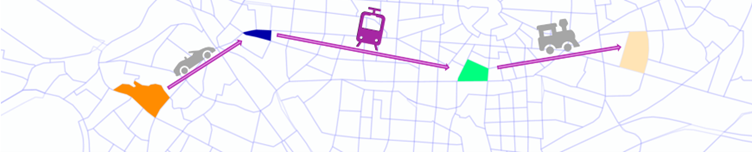
Illustration 177: Illustration of an intermodal path sequence car - long-distance rail - local rail. In this example, long-distance rail is obligatory, while cars and local rail are optional feeder services. The transfers take place at zones.
Intermodal assignment is closely linked to the impact models of private and public transport. Illustration 178 illustrates how they are connected.
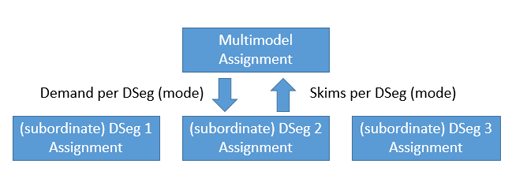
Illustration 178: Connection between multimodal assignment and impact models of private and public transport
In the context of intermodal assignment, paths are often mentioned that are covered with different modes. As in Illustration 178, these are, strictly speaking, demand segments.
Skims are calculated based on the assignment of subordinate demand segments. These skims form the basis for determining the impedance on paths that can be part of path sequences.
The impedance of a path sequence is made up of several additive impedance components, some of which may remain empty. These impedance components are defined for each subordinate demand segment:
-
Access: Access to the start zone of the first path leg. This component is only evaluated for the first part of the path sequence.
-
Matrix: Change in location from the start zone to the destination zone of a path leg.
-
Transfer: Transfer to another subordinate demand segment. This way, for example, it is possible to model in the above example that the transfer from a car to a long-distance train takes longer than from a cab.
-
Egress: Egress from the destination zone of the last path leg. This component is only evaluated for the last path leg of the path sequence.
The result of the intermodal assignment are path sequences and their volumes. The demand of the subordinate demand segments can optionally be calculated and saved in the corresponding matrices. If travel times are also defined for the subordinate demand segments and matrix time series are defined for the demand, the temporal offset can also be taken into account when calculating the demand.
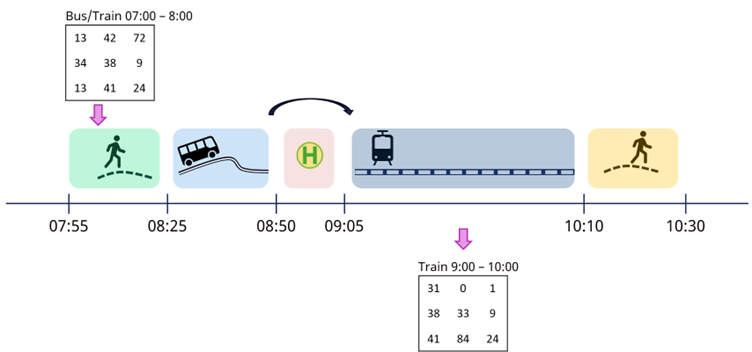
Illustration 179: Calculation of demand for the subordinate demand segment Train, taking into account the temporal offset due to path legs taking place beforehand
The path legs, or more precisely path sequence elements, start and end at zones. Their exact courses in the network are not the result of the calculations. However, they can be shown as examples in the network if the subordinate demand segments are also assigned. In this case, flow bundle calculations can also be carried out for the path sequences.