Platoon Dispersion Model
Important for coordination is the behavior of the vehicle platoon during the journey from one Intersection to another (or: one Signal Group to another). PTV Vistro determines platoons by analyzing the movement based total analysis volumes. It is calculated how many vehicles on their way first pass their Signal Group at the first Signal Controller and then their Signal Group at the second Signal Controller. We call such a combination of two consecutive Signal Groups with one volume a coordination path leg.
Optimization treats the traffic flows on all path legs interdependently. In each case it is assumed that within a cycle all vehicles start as a platoon at the beginning of the green time.
This means, that beginning with the green time start, outgoing vehicles flow off with the saturation flow rate, until the volume per cycle has been exhausted.
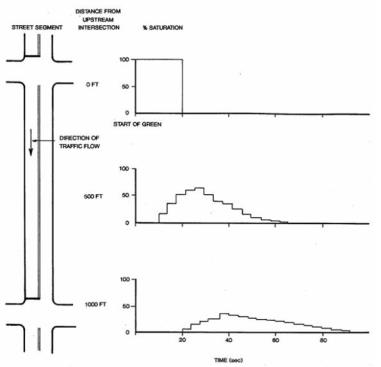
The platoon resolution or dispersion, solely caused by different vehicle speeds, describes the platoon development formula according to Robertson 19691. This model discretely divides the time in increments of 1 second and displays the number at time t‘, at which a vehicle arrives at the end of a coordination path leg as a function of the number at time t < t‘, at the beginning of the coordination path leg departing vehicle. (see section A simple case of Platoon Dispersion (Source: Figure 3-19 from Traffic Control Systems Handbook, Chapter 3 [FHWA])) shows a simple case of platoon dispersion between two intersections:
Figure 39: A simple case of Platoon Dispersion (Source: Figure 3-19 from Traffic Control Systems Handbook, Chapter 3 [FHWA])
Number of vehicles arriving at the end of the coordination path leg is calculated as follows:

 : Number of vehicles arriving at the end of the coordination path leg in time step t
 : Number of vehicles departing at the beginning of the coordination path leg in time step t
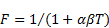 , a = 0.35, b = 0.8
 : Travel Time on the coordination path leg (based on user defined approach speed and distance)
For calculating queue lengths, it is presumed that separate lanes of sufficient length exist for separate Signal Groups at an approach. PTV Vistro generally assumes vertical queues and does therefore not consider spillback upstream over several links or have an effect on the capacity of the turns of other Signal Groups.