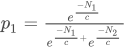
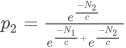
Calculation of the velocity variance and experienced velocity variance
Vissim records values of the Velocity variance of pedestrians in the Vissim network during a simulation run in the following evaluations, if these are selected:
- Area evaluation, ramp evaluation (Output attributes of area and ramp evaluation)
- Grid cell evaluation (Grid-based evaluation of pedestrian density and speed)
Vissim records values of the Experienced velocity variance attributes for each pedestrian in the Vissim network during a simulation run (Showing pedestrians in the network in a list).
Calculation of the velocity variance
The velocity variance in km2/h2 is calculated using the following formula:
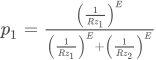
Where:
|
NT |
Number of time steps so far in the evaluation time interval |
|
|
This sum includes all NP(tj) pedestrians which are on the area, ramp or in the cell at time tj |
|
|
Number of measurement points recorded This is the number of pedestrians summed over all time steps in the time interval. vi(tj) denotes the 2D velocity of the ith pedestrian at time tj. |
|
|
Average velocity value |
|
N=1, Var(v)=0 |
|
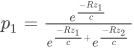
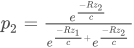
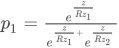
Calculation of the experienced velocity variance
The Experienced velocity variance should represent a size that reflects the Impedance of a pedestrian (the ego pedestrian) to other pedestrians in close proximity:
- The experienced velocity variance is ZERO if all pedestrians are walking in the same direction at the same speed.
- The experienced variance is > ZERO if all pedestrians are walking in the same direction, but the ego pedestrian is walking slower or faster than the other pedestrians in close proximity.
- The experienced velocity variance is also > ZERO if all pedestrians are walking at the same speed, but the ego pedestrian is walking in the opposite direction.
- The experienced velocity variance increases the more the pedestrian's direction deviates from the directions of the other pedestrians. The deviation goes from the parallel direction to the opposite direction, at the same speeds.
The calculation of the experienced velocity variance ℇi(t) at time t of an ego pedestrian i is based on the calculation of the velocity variance:
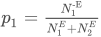
Where:
|
vk(t) |
2D velocity of the kth pedestrian |
|
|
Number of pedestrians (neighbors) in the immediate vicinity of pedestrian i. Limited to the central cell and the eight immediate neighboring cells surrounding the ego pedestrian, this immediate vicinity includes all pedestrians surrounding the ego pedestrian that are determined by the values of the following attributes from the network settings for pedestrian behavior (Selecting network settings for pedestrian behavior):
|
|
For |
|